Back on the move toward Miami

Could almost hear the sound of Velcro being ripped apart as we departed from the mooring ball we’ve called home for the past two weeks. Who would think that “maybe 3 days” would turn into 2 weeks? We are not alone in that occurrence, every mooring ball has 2- 3 boats on it and many boats were here when we arrived and are still here.

Vero was the place that we knew existed, but hadn’t encountered.  We were adopted by POLAR PACER, a perfect match-up as we are the new kids on the water and they are still fairly new at 18 mos, yet extremely knowledgeable and eager to share. We met other couples, some even younger than us and hosted many a night of cruiser tales and Mexican Train Dominoes. A loan of SANUK’s Tiki Bar sign – a failed sneak attempt to hang and run- gave us party boat status.
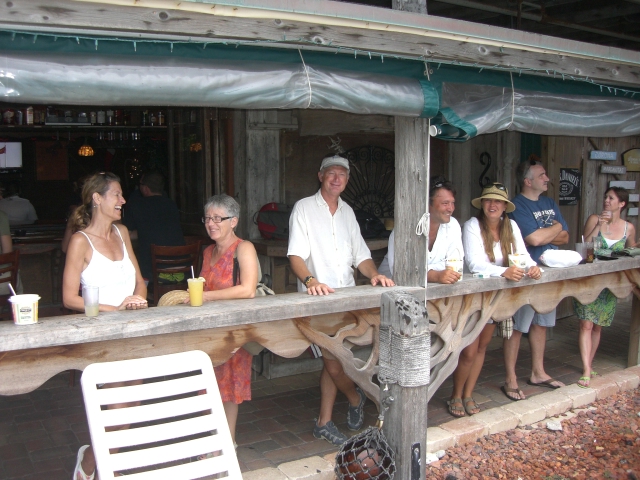
Taking shelter at Waldos

Two trips to the beach were unsuccessful in terms of sun and swim, but thanks to Waldo’s beach bar and restaurant, we were saved each time.  Voodoo Juice served in 32 oz plastic buckets – you keep the bucket- was the group favorite. Tracy (SANUK) wins the prize for best duplication of a bar drink- thanks for sharing your home made version!

In between fun stuff, we worked on boat and sewing projects, shopped twice at Publix, visited Panera for breakfast goodies and took the local bus to Lowes and Target. We discovered The Fresh Market, a budget breaking near twin of Whole Foods and restrained ourselves to only fresh meats, fruit, eggs and a very small bag of Praline Bourbon Pecans that I simply had to have.

As a small reward for tearing ourselves away, we spotted a manatee in the ICW channel; our first sighting.  Florida waters contain many areas with slow speed signs due to the manatees.
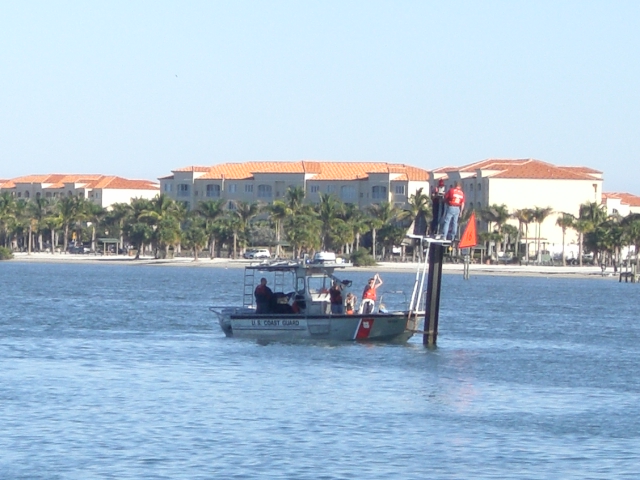
Coast Guard repairs a red ICW marker

The above photo is a rare sighting of Coastguardius Marker Reparius. More than makes up for the lack of a manatee picture.

Starting to count the days until Benj arrives on Dec 22. We’ll have plenty of time to get the lay of the land (water actually) before he arrives. Our box of Christmas decorations will be opened soon as we attempt to “think Christmas” in 70 degree weather. Ok, not complaining. Happily, his only food request was for lots of fresh fruit. Think we can mange that.

Weather permitting we will leave here at some awful early hour Wednesday morning and go (sail?) outside for a long day to Miami. Worst case, we can come in at Ft Lauderdale if the Atlantic is not a kindly as hoped.
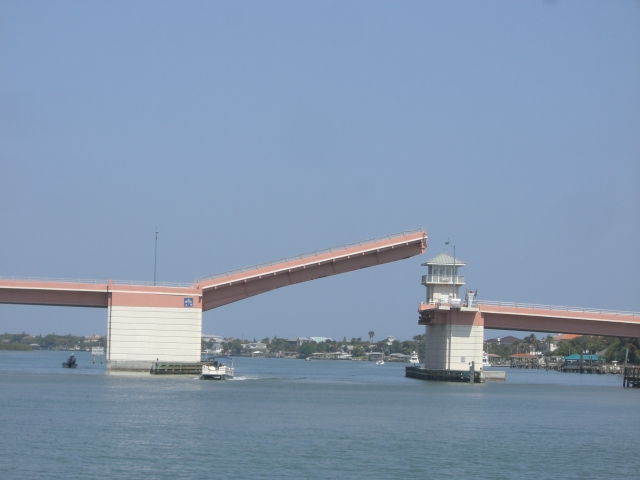
Bridges over the ICW

Single Bascule bridge- very roomy

Today, we began planning our trip to Miami from Velcro, I mean Vero Beach. We have easily fallen into the habit of saying “Velcro”. Rolls off the tongue so smoothly.  Our raft buddy. POLAR PACER, left today as did our mooring neighbor,  SANUK. I think the wind kicked up more than expected for them.

As I looked ahead in our ICW guide, I couldn’t help but cringe at the plethora ( yep, my word of the month) of restricted bridges and thought now was as good a time as any to describe these structures and their role in our trip.

The 1,095 miles of the Atlantic Intracoastal Waterway (ICW for short) contain 137 bridges of which 81 need to open for sailboats (and many powers too). In the last 130 mile stretch there’s 41 opening bridges of which 22 are restricted.

The styles of bridges are varied: swing, bascule (hinged and raises open from the hinge), fixed (non opening) – 99% have 65′ clearance at high tide, lift (railroad only) or pontoon. We’ve only encountered two lift bridges, both just south of Norfolk. They function as the name implies, they lift up parallel to the ground attached to metal tower-like structures on each side of the waterway. Massive describes them well.  The ICW contained one pontoon bridge which we show above. Two weeks after we went through, it was taken out of service having been replaced with a fixed bridge. The ICW also has one automatic single-bascule railroad bridge at Mile 876 (Titusville (NASA)) which we passed through on our way here. It’s usually open, but when a train in due, the green lights will change to flashing red and a horn continuously sounds four blasts for eight minutes. At that point the bridge will close as long as the scanning equipment shows nothing under the bridge.

If a bridge is of the opening variety, then life becomes more interesting and boredom can be greatly reduced.  The flavors are: restricted, on-demand or a mixture of the two. The flavors can alternate between weekends and weekdays.  If a bridge is always restricted to a set schedule you simply have to adjust your speed and take into account the myriad of factors that can influence your speed and ability to make the desired opening time. A common schedule we encountered prior to Florida was “Open on the hour and half hour”, but there were bridges that only opened on the hour. When you have several of these types in a 15 mile span, the calculator and chartplotter are your friends. Florida has a plethora of bridges, but we were recently on a joy run of no opening bridges for 79 miles!
On-demand bridges provide an opportunity to talk, however briefly, with someone new. If you want to communicate with a bridge tender, you call him or her on the appropriate channel using the VHF marine radio. Most states use Channel 13, but some like Florida use Channel 9. Channel designation is regulated by the Coast Guard. Channel 16 is the “monitoring” channel and the one used for distress calls.
A typical bridge hailing would go something like this: (first be sure you are on the correct channel) “Wappoo Creek bridge this is the southbound sailing cat requesting an opening.” With any luck you have another boat or two behind you. The bridge will acknowledge your call and indicate that they will open when all boats are close enough. For some reason that we have yet to figure out, bridgetenders will often ask for the boat name AND where from. This occurs when several boats are making the passage. Once you are clear, most vessels will thank the bridge tender for the opening and say they have cleared the bridge.
Most bridge tenders are friendly and courteous.  One clearly enjoyed her job and she was a hoot! A real southern accent and she was talking to each boat like we were best friends.  “Keep it coming darlin’, watch that crab pot in front of ya. That’s it. Y’all have a good day now.”
The trick to ensuring a prompt response to your call is to use the correct name of the bridge, be polite yet confident and provide the necessary info clearly. If you see a boat a short distance in front of or behind you, indicating that you will slow down or speed up for the opening is always an appreciated gesture.
We can’t wait to do the bridge dance again, real soon.