Cats and more cats

Fast moving multi-hull

Fast moving multi-hull

Do you find the origin of words fascinating, or least interesting? I do. Find myself delving into word origins more and more; and hey it’s easy these days. How about this word: “catamaran”? The other night Russ and I tossed around some possible countries of origin and you might be doing the same right now …but we didn’t get it right. Try this: India.

You can check it yourself but here’s the Cliff Notes version: In and around India, vessels which looked to be nothing more than one or two lightweight pieces of wood tied together, were called Kattumarams in the Tamil language. (Tamil is one of 22 languages of India and one of the oldest surviving classical languages in the world). The word meant literally, “tied wood” (from kaṭṭu “to tie” and maram “wood, tree”). When English visitors encountered the swift and stable boats used by the Polynesians two widely spaced canoe-type vessels tied together, the same term was applied and thus today we have catamarans, or “cats” for short.

The same day of the catamaran word history tour, we drove down to lovely Wiscasset then lunched at Mine Oyster in Boothbay Harbor. I walked into only one shop in Boothbay Harbor (yes, I am feeling just fine) where local crafts and other interesting Maine items are sold. One book cover caught my eye; a stunning photo of a Maine Coon cat. Ah yes, the Coon Cat.

Captivating Coon Cat

Captivating Coon Cat

I smiled because if you Google that or do any search for Maine Cat, guess what comes up first? Yep, the Maine Coon Cat, which we never investigated, probably because we were too focused on that Maine Cat catamaran.

That same evening, there we sat at our tiny dinette table, sipping our Happy Hour libations and minding our own business. We sat inside because thanks to a cold front, the day was chilly, chilly and windy, windy. You get the picture. Our window looks out toward…….. not much, just open space, a barn, a few trees (one fallen) and grassy tent sites beyond. Movement caught my eye and I saw what looked like large, furry cat-like creatures; two of them.
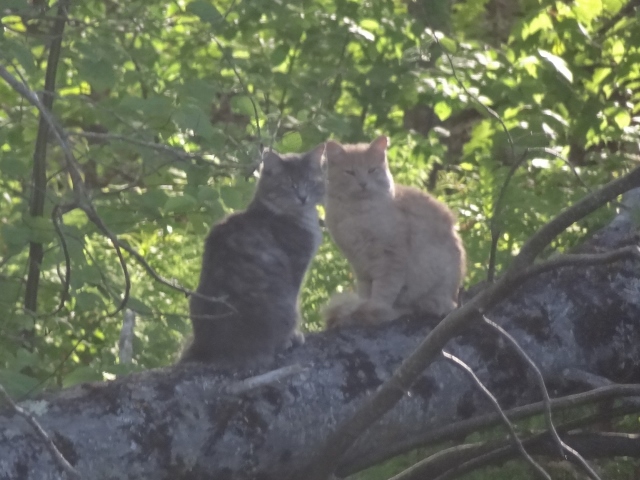
He and she Maine Coon Cats

He and she Maine Coon Cats- taken through window so as not to scare them off

We know next to nothing about cats….. but we do love the ones our family and friends have and share such wonderful photos of!! 🙂 More research was in order and you can just call us your nomadic research assistants for all we routinely Google; most of it we don’t trouble you with!
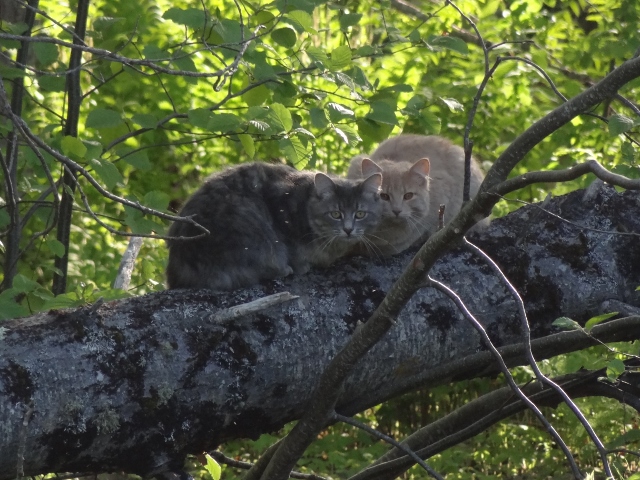
Russ gets their keen attention

Russ gets their keen attention when he steps outside

Maine Coons are quite special; known as “gentle giants”, they are the largest domesticated cat breed in the U.S. and are now one of the most popular cat breeds in the world.  One of the oldest natural breeds in North America, especially native to Maine where they are the official state cat. Can you believe, a Maine Coon cat won the first North American Cat Show in 1895? Intelligent, excellent hunters with long fuzzy/bushy tails and medium to long hair, the one feature that assures you that you are indeed staring at a Coon cat is their slightly tufted ears. Look carefully at their ears in the above photo: see?

In the photo below you get a good look at the female’s tail. How do I know that she’s the female? At first I just labeled the light-colored one the female, but then …. well Spring IS here and love is in the air. 🙂
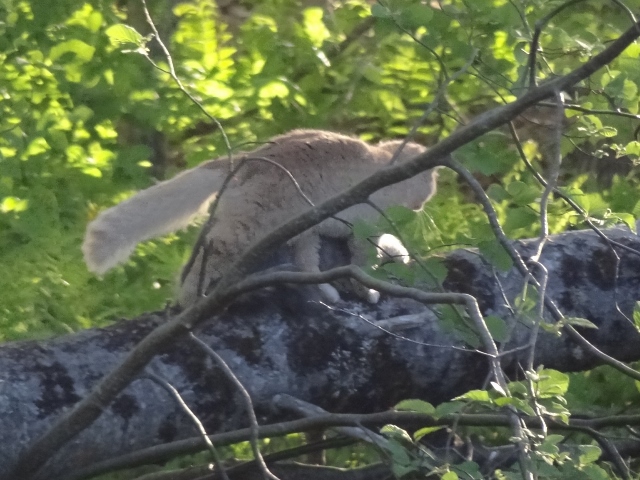
Pardon me sir; I take the front seat.

Pardon me sir; I take the front seat.

Now about that name; two folk tales seem to be the most popular, with the more ordinary one (naturally) being the more likely. My favorite goes like this: in 1793 when Marie Antoinette, Queen of France, tried to escape from France (probably to her relatives in Quebec 🙂 ) she brought her beloved Turkish Angora cats with her. She never made it, but her cats – with their nine lives- made it to the Wiscasset shore (weren’t we just there?) where they bred with the local short-haired cats and thus today- oh wait-people who first saw the new version must have seen dark-colored ones and though, “raccoon”. Romantic and all but not very likely.

The generally accepted theory among breeders also involves ships and the sea; perhaps not as boring as I led you believe. A seafaring trading ship Captain, Charles R. Coon often put into port in New England and his brave many-lived long-haired cats traveled with him. In classic literature what happens when a ship stops at a port? The sailors rush to the taverns, eager for brews and wenches. This wild abandon activity would surely include the cats aboard, eager to get away from a ship that offers not one speck of decent kitty litter! When the local population noticed cats similar to the ship’s long-haired cats with a touch of ‘common’, they called these felines “Coon’s Cats”. Take your pick, find another or make up your own story; but if you have a better one, you’d better share.  P.S. I gave Captain Coon the middle initial “R”.
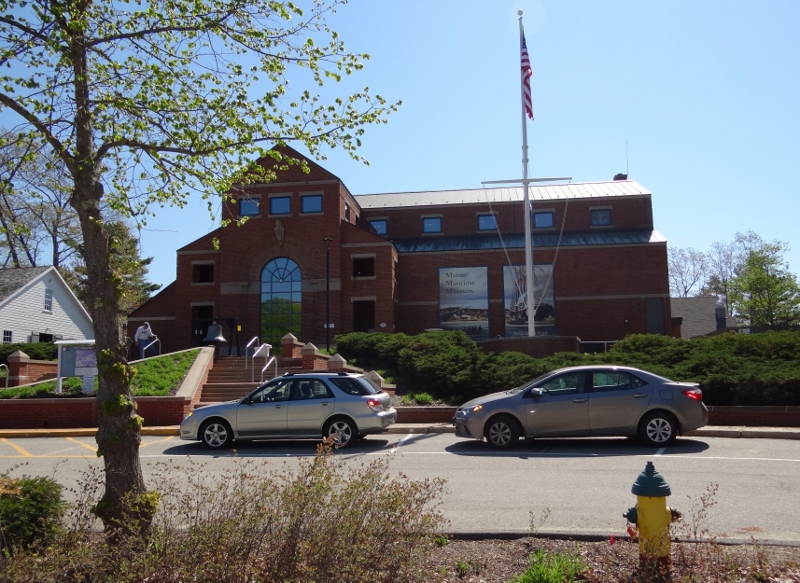
Maine Maritime Museum

MAine Maritime MuseumIn direct contrast to much of Florida, Maine does not have a Walgreens or CVS on every corner. Bet that doesn’t stop Maine folk from being healthy and happy! But allergy med refill time was upon us and the nearest Walgreens sat 40 mins south in Bath. Bath sits on the Kennebec River and is home to Bath Iron Works (BIW), The Maine Maritime Museum, Chocolate Church and a slew of tempting shops, galleries and eateries.

Bath Iron Works’ skilled workers build and repair US Navy warships and we could see a fair amount of work in progress as we drove past.

The huge dry dock at Bath Ironworks is visible in the background

The huge dry dock at Bath Iron Works is visible in the background

Our destination though was…. Can you guess?   The Maine Maritime Museum! A cross between a smaller version of Mystic Seaport and Maryland’s Chesapeake Bay Maritime Museum, the MMM provides an affordable way to experience Bath’s connection to the sea. We learned about shipbuilding, the sea trade, lobstering and the dangers (and thrills) of sea life through exhibits, displays, models and paintings.

wooden carved chain

An amazing accomplishment: carved interlocked “chain” from a single piece of wood

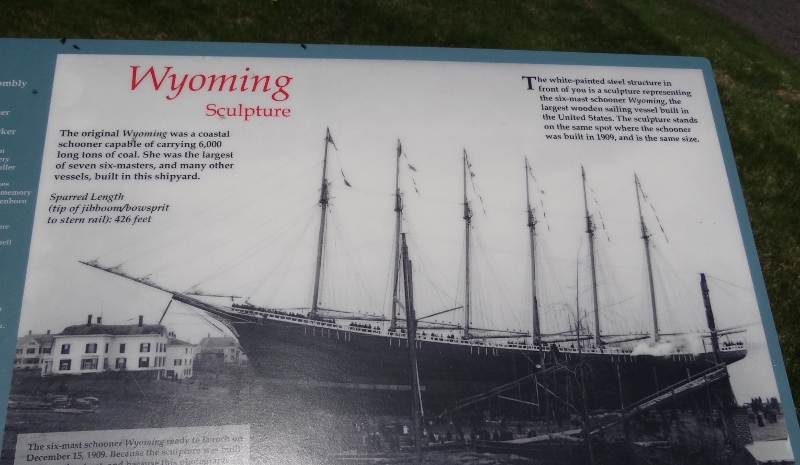
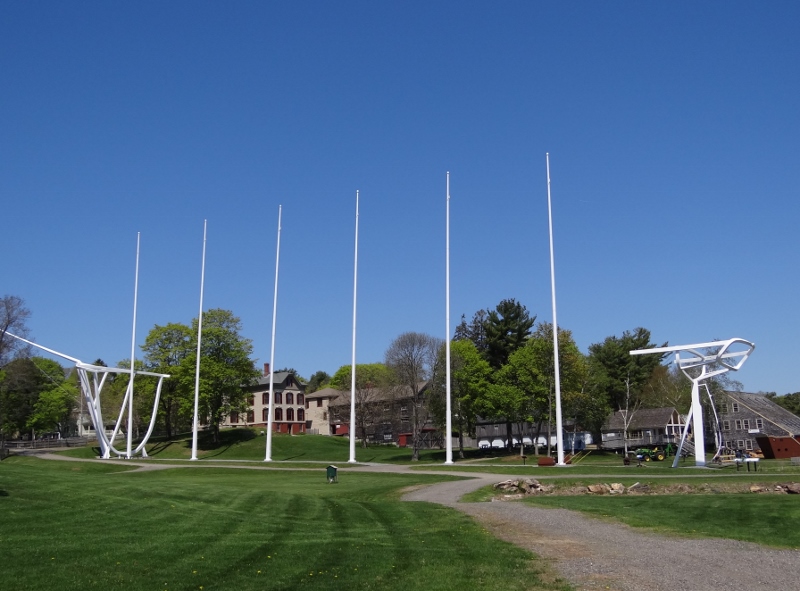
The grounds contain buildings with permanent and changing exhibits, a snack bar, kid’s pirate play ship and human size lobster trap, docks with tour boats, a pier for visiting ships and a full-sized evocation of the Schooner Wyoming. We estimate the museum covers 8-10 acres. During the 1800s, 3 shipyards occupied these acres; one of them built and launched the largest wooden sailing vessel in the U.S., the Wyoming. Amazing how ships could be designed and built from the ground up, starting with, “let’s get those local trees felled and brought in.”

Compare this,

Compare this,

to this, honoring the Wyoming.

to this, honoring the Wyoming.

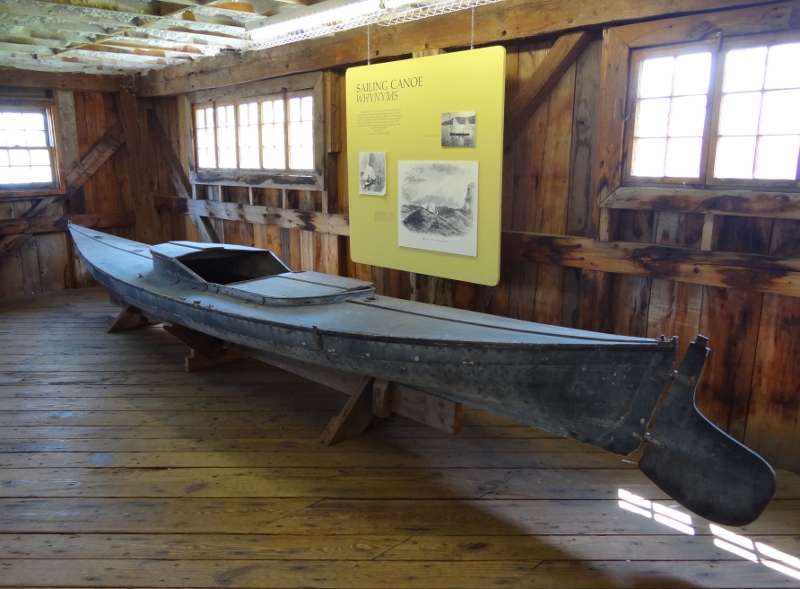
A precursor to the kayak? the WHYNYMS

A precursor to the kayak? the WHYNYMS

The museum has a reference library upstairs in their main building and it is open on Tuesdays and Thursdays, or by appointment. Today was Thursday so Russ wanted to see what might be dug up on the schooner Ortolan, our boat’s namesake. If you haven’t seen the teeny post way back in 2009 about how we named our boat, click here. Well, we got a hit right off; two Ortolan names came up and one just HAD to be her. The dates and her size fit perfectly with the info we had, but no owner, master or captain’s name was Rackleff (just one of many versions), so that was puzzling.

Needless to say, Russ dug up the document then began an intensive online search. The library provided this: Registered in Wiscasset, 74 ton schooner built 1848, 67 ft long by 17.5 ft wide, unknown builder, Henry Barter listed owner with Isaac Barter as Master in 1849.

From the various records and genealogy data we have or found, we are certain that the two-masted schooner, Ortolan, belonged to Captain William Rackliff who sailed her with his daughter, son William E. and seven others aboard from Portland, ME to San Francisco, CA.

Cap’n William made his living involved in the vast, varied and difficult Maine fishing industry. Seems he, like so many in the mid-late 1800s, felt the call of “the west”. The voyage began in late 1849 (why the rush to head out with winter coming?). Captain and crew survived a broken mast, being chased by pirates 🙂 and stormy seas around Cape Horn, finally arriving in San Francisco on August 5, 1850. They hung out doing whatever intrepid voyagers did back then, for two months, before sailing north to southern Oregon’s Umpqua River. There they (not sure if the un-named others got off in SF or continued) crossed the bar to sail Ortolan up to the trading center of Scottsburg where they (assuming we are talking Rackleff) settled into farming.

In 1850, Captain Rackleff purchased land, began building a home and sent for his wife and young son who arrived in San Francisco via the Isthmus of Panama. The family was industrious; their Oregon legacy long, their progeny many, their ship building continuous and farming didn’t last but eight years before William, being a seafaring man, built a schooner Twin Sisters and with her began trading and operated a trading post.

So what happened to Ortolan? Apparently the Captain sold her (proof that he owned her and was just not chartering her) in 1852 which was some time after Mary arrived because Ortolan carried her from San Francisco to Oregon. William then purchased a pack of mules to carry supplies; one way only because he sold them soon after. Digging a bit further Russ read an 1860 NY Times tidbit that said a schooner Ortolan, from San Francisco returned from a long-distance unsuccessful gold prospecting trip; “the soil was brilliant with mica, which accounted for the marvelous reports.”

On a vessel level, the take away is that Ortolan left Maine in haste, serving her owners well, then when sold she again proved herself solid and able. On a human level, the take away that I see is you can take the man away from the sea but not for very long!