
Elizabeth Harbor and her many well-named and well-known anchorages is called “chicken harbor” by those who are not drawn into the fun and games winter community. Many of these floating cottages that look amazingly like boats, never (or just no longer) venture farther south than Sand Dollar Beach.
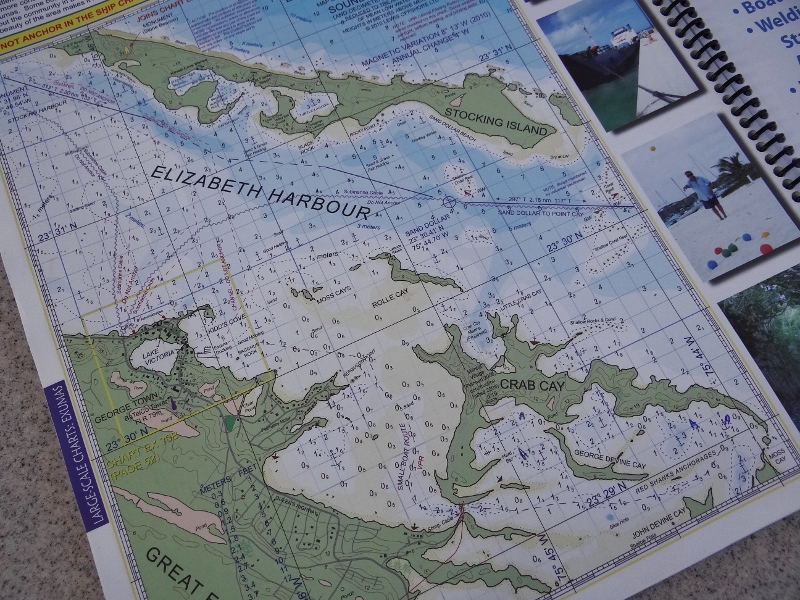
Elizabeth Harbor with Stocking island anchorages near the top and Red Shanks near bottom right
Even if the extensive list of activities does not interest you: beach yoga, beach volley ball, beach church, softball, table games, beach get-togethers (bonfires, happy hours), the more reclusive can engage in numerous solitary activities too: beach walking, swimming, kayaking, lounging about and burying your nose in a book or whatever happens to be your current hobby or interest.
One very common activity is called the “George Town Shuffle” where boats move among the four primary anchoring spots (Monument, Volley Ball, Sand Dollar, Kidd’s Cove) for either a change of scenery, to get closer to town and Lake Victoria, to get closer to the night’s beach event or to snag a better (more protected) spot. Some boats don’t shuffle, their anchor in all the way to China with several remoras likely attached to their hull too!
A fifth area called Red Shanks Cays, comprised of Crab Cay and several tiny cays is out-of-the-way and feels like you’ve been banished from George Town. But it has something the other anchorages don’t have; excellent 360 degree protection and great holding throughout. So if the main harbor is “chicken harbor” then surely Red Shanks is scared-y cat hole. Cats and other shallow-draft boats can find plenty of ideal anchoring space- the kind where you are not on top of your neighbor able to read their books too. Boats with deeper draft have less room, but still enough for 8-10 just inside by Moss Cay.
We’d gone to Kidd’s Cove Monday evening for quicker and easier dinghy trips in and got reasonably decent SE wind protection. Cathy was leaving late afternoon Tuesday and this would give her another area to explore via kayak. By Wed with all our trips to town complete and 7/8 full with water, we headed over to Monument for a construction site check and to touch base with a few cruiser friends.
Five o’clock found us heading into Red Shanks Anchorage and very surprised to find at least 15 others already there. We snagged a good spot and I proceeded to figure out who were our neighbors. The most enticing advantage weather-wise to being this far south in the Bahamas (vs Abacos or even northern Exumas) is that the cold fronts often stall before reaching here or they fizzle and are not as severe when they do get here. The worst wind pattern is when the wind clocks around, say starting out from the NE, moving to SE the next day and over a shorter time period going to south then west with a healthy dose of wind greater than 20kts. One minute you are sitting calmly in the lee of land and during the night (almost always at night) you’ve rocked around the clock with your stern facing the shore and your bow greeting the increasing waves that even in the harbor become uncomfortable. Heavier boats sit more comfortably in these conditions than Ms. Ortolan who is a light-weight in her class. Assuming that your anchor hasn’t dragged because it couldn’t reset as it got pulled around, or one of your neighbors hasn’t gotten extra friendly and dragged into you, well now you feel pretty darn lucky.
Perhaps now you’d like to head to the beach or to some other spot with wind protection; that would require dinghy transport. This is the part that gets dicey for us. When Ms Bunting is launched, raised, boarded or exited, her bow goes under the bridge deck in the space between the scoops. If the waves are more than moderate the bow gets bashed up into the underside of the deck and we stand a good chance of ripping off the bow light mounting fixture which sits under the chaps, or worse, ripping the blue abrasion fabric as it gets pulled against the raised Achilles emblem just below. Having this happen once was enough to make us extra cautious to the point of saying, “nope, don’t need to get off and stretch my legs, I’ll just run up and down the steps and do cartwheels on the tramps.” Right 🙂
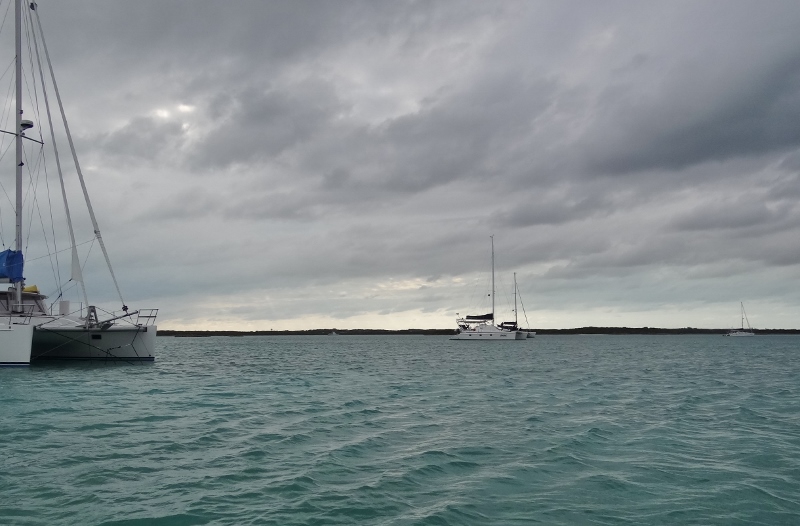
A few of the catamarans anchored in Red Shanks- this was one of our nicer days
In Red Shanks the wind can howl at 20kts and we can safely launch the dinghy and the kayak. Our Rocna loves it here too; she just buries herself like a clam, refusing to dislodge even when it’s time to go. Dolphins came by regularly and on Friday afternoon (the only few hours of partial sun in five days) one swam slowly around the boat six times. Yvonne and Brian on Options III were visiting and we all ran out to watch the show. Hey, it’s the little things.
As I write this on Jan 22, we are hanging out in Red Shanks again thanks to another cold front that thankfully wasn’t the very windy, rainy, no sun event that the first one was. Let me jump back to how the first one progressed to give you some idea of what we experience. Those of you who have “been there” can proceed to the comment section and share your favorite or most exciting event of this nature. 🙂
Wed afternoon: winds out of the SSE 11-16kts, partly cloudy, high temp 79
Thurs morning 3:14 am: I know the exact time because I looked at the iPhone when I got up. Wind moderate until then. The rain began and that’s when we got up. Was enough moonlight to see fairly well and I watched the boat swing from south to NNW, nearly 180 degrees, in less than a minute. Looking off the stern to the south you could see the dark rain clouds as they began to cover the sky and soon we had pouring rain and very dark skies. The wind picked up to 26kts steady and other boats reported gusting to 32kts which I totally believe. We’d turned off our electronics after a short time so only had brief wind speed info. Boats here appeared to have done the swing dance just fine, but we did see red and green lights over by the line of mostly monos anchored along the edge of the entrance channel. The wind shift put their sterns toward the tiny cay. On a worry-scale of 1-10, I’d give this a 3.
Thursday: wind NW 10-26kts, overcast all day but no further rain or squalls as had been forecast. High temp 73, brrrr
Friday – Sunday: a steady, daily drop in the high temps from 74 to 70. Wind NNW – N, mostly over 15kts. We learned that a boat did drag anchor when the wind shifted and picked up; the lights were on the dinghies helping get the boat re-anchored. They were lucky. A sand bar kept the boat from hitting the rocky cay behind them. Nothing, at least cruising-wise, worries us more than dragging into another boat- and taking them along for the joy ride. When the sun popped out on Friday, Russ checked our anchor and she’d turned beautifully in place like, well, clock work.
We re-connected with s/v Little Sister, our conch cleaning trainers who we met last Feb. We learned that Steve (and dog Charlie) deserves the thanks for keeping all the trails clear, but he says it gets interesting when walkers run into him and his machete along the paths. So Steve here’s a public thank-you for all your labors so that others can enjoy walking around Stocking Island. I am sure that most cruisers don’t know who does that for us.
Finally on Monday we came out of our hide-y hole which made the engines and batteries happy, and anchored at Monument so we could attend the first beach happy hour of the season. Everyone is invited, whether you are a member of ARG or BRG (Alcohol Research Group or Beverage RG); just bring what you like to drink and an appetizer to share, some boat cards and talk with people you haven’t met. Check, check and check! An entire armada of boats sailed in that day and the harbor was noticeably bulging with boats at all anchorages, including the spaces in between.
Early Tuesday we headed to Kidd’s Cove for another round of jugging water (5 trips x2 5gal jugs=50 gals), stops at the library, Exuma Market (twice; the second time the avocados had arrived!!), ATM, liquor store and to dump our large black bag of garbage for $2. Low NNE winds made for a lovely day and the sun graced us with an occasional appearance.
Now, back at Red Shanks we sit hardly noticing the beautiful blue wavelets; if not for the wind howling you’d wonder what the fuss was all about.
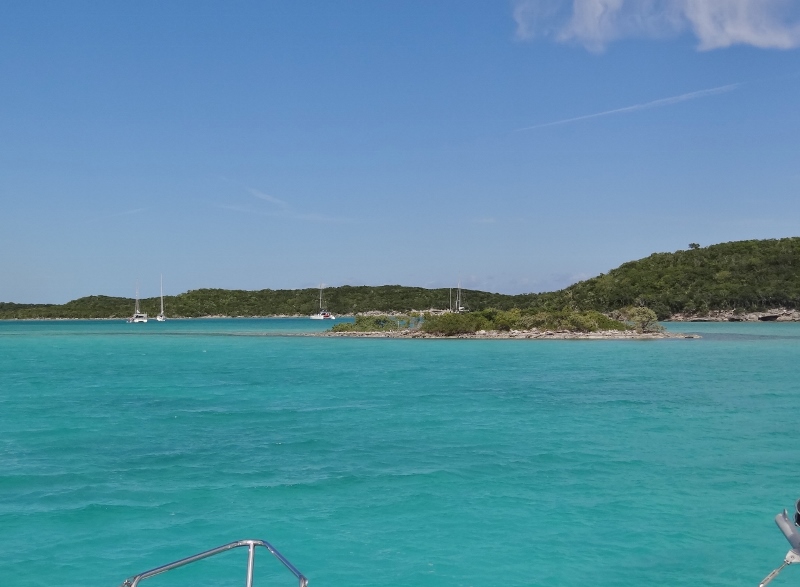
The second front was much brighter than the previous and less wind- no dragging reports either


 Cruising along the East Coast and Bahamas