Queen of the Fleet

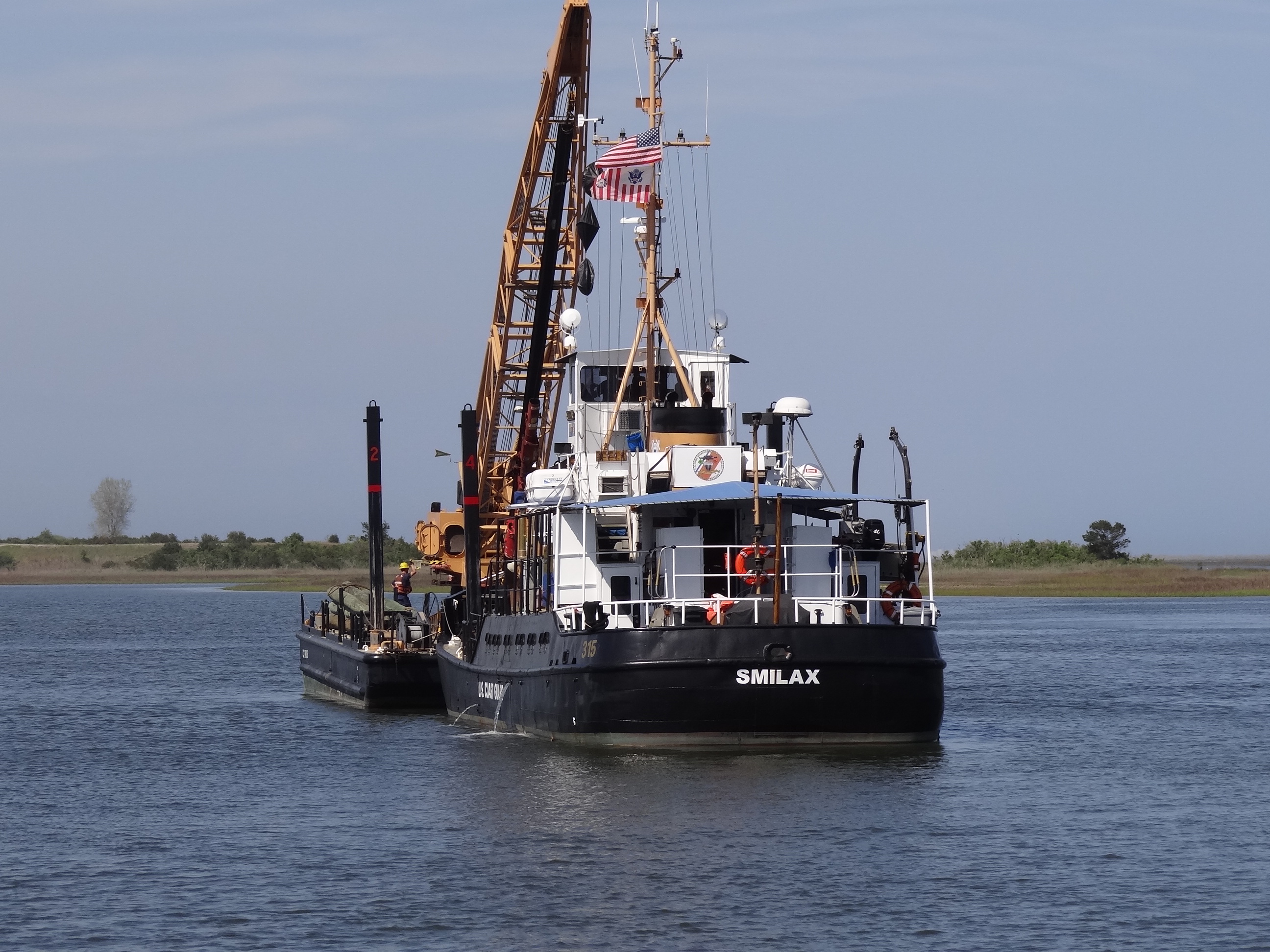
CG Cutter Smilax and her work barge replace ICW daymark near Carolina Beach

CG Cutter Smilax and her work barge replace ICW daymark near Carolina Beach

To pass the time and keep my mind from getting too mushy, I pay attention (often to the extreme) to the names of boats we meet, see along the way or simply hear on the VHF. Boat cards go in a large bill-fold like keeper that was originally designed for business cards. In addition, when we began cruising I grabbed the nearest pad of paper and started writing down the names of boats we interacted with or just heard them a lot on the VHF. This compulsive behavior (bet you have one too) doesn’t carry over to commercial or government vessels unless the name or situation is unusual- but if that’s the case then a photo was probably added to the thousands I’ve taken.

In mid-April during our very short trip from Carolina Beach to Wrightsville Beach, NC we passed by the CG cutter Smilax, who, along with her work barge, was replacing intracoastal marker G153 along the channel’s edge. Being a very impressive and new sight for us, I quickly put the binoculars and camera to work and made a short notation in the log.

Fast forward to late summer and a chapter in the book, Ghost Ships by Richard Winer the author of The Devil’s Triangle. The paperback is a compilation of 33 true stories of nautical nightmares, disasters and hauntings. One of the chapters details several bizarre encounters that Coast Guard vessels have had over the years. The first one starts off, “In October 1954, the Coast Guard buoy tender Smilax was proceeding north from Brunswick, GA, to various points along the South Carolina coast…….” Wait a second. My brain whirred as I thought back to the CG cutter we’d seen in April. Yes, I know she was the Smilax. I’m known for saying, “we’ve seen that boat before.” Could this be the same vessel 59 years later!!?? A quick google and sure enough, she’s one and the same. The all-knowing Wikipedia provided proof-positive photos and historical info, some of which I’ve included here for your reading pleasure.

“Smilax was built by Dubuque Boat & Boiler Works in Dubuque, Iowa. Her keel was laid on 26 November 1943, she was launched on 18 August 1944, and commissioned 1 November 1944. Built as a 100-foot bay and sound tender at a cost of $194,238, she required a year to build at a time when most ships were built in 40 days, making her the most expensive ship of her class.

After commissioning, Smilax was assigned to the Seventh District and was stationed at Fort Pierce, Florida where she engaged in the aids to navigation mission. From 1 June 1954 to 9 November 1965, she was homeported out of New Smyrna Beach, Florida. While stationed in Florida she assisted on several search and rescue cases.

After twenty years of service, Smilax was refitted with new engines, and given a 70-foot barge.

In July 1999, Smilax moved to her current homeport of Atlantic Beach, North Carolina, relieving her sister ship USCGC Primrose (WLIC-316) of her aids to navigation duties.

Smilax‘s mission, since her commissioning, has been to service aids to navigation, ensuring the safe navigation of mariners. From her current homeport she is responsible for maintaining 1,226 fixed aids to navigation such as lights and range markers. She is also responsible for 26 buoys throughout the Outer Banks of North Carolina.

March 2011, upon the decommissioning of USCGC Acushnet (WMEC-167), Smilax became Queen of the Fleet. Queen of the Fleet is the oldest commissioned cutter in Coast Guard service. This distinction is denoted by gold hull numbers on the bow of the ship.”

How cool to have seen the Queen of the Fleet in the year she will turn 70 and to know her story.

Footnote: on October 28, 2013 while we happily beachcombed at Cape Lookout, Smilax was lifting cannons from the wreck site of the Queen Anne’s Revenge; Blackbeard’s ship.

Into the Groove

The shrimp boats sure catch a lot of seagulls! We are two miles to Cape Lookout

The shrimp boats sure catch a lot of seagulls! We are two miles to Cape Lookout

Warm day, clear water, long stretches of shell covered beach dotted with dunes, dinghy in to the beach and step into water; sounds much like the Bahamas to me. Ignore the very deep water (we dropped the hook in 26ft), the lack of rocks and coral (both in and above the water) and you could easily be convinced that your wish to “just get there!” had miraculously occurred. We joined a handful of other cruising boats who appeared content to admire the shore from the comfort of their vessel.

Looking out toward the Atlantic at Cape Lookout

Looking out toward the Atlantic at Cape Lookout

Armed with my usual tools of the beach combing and photo-taking pursuits, we headed ashore with plenty of beach exposed near low tide. How many is a bazillion?  Ok now double that. A veritable shelf of shells lined the beach on the inside (bight side); the ocean side even more.  No trip to North Carolina’s Outer Banks should skip Cape Lookout; sitting at the end of the line so to speak. Part of one of world’s last natural barrier islands, Cape Lookout offers something for everyone; from PWC-ers to hikers and cruisers. Small boats spent much of the day net fishing close to shore. They looked successful.

Sand, shells toes on the beach- life is good!

Sand, shells, toes on the beach- life is good!

For one day we’d be in the groove of sun, sand and beach; zooming over flat calm waters in Bunting, our only concern being how could we see the most in one day?

The lighthouse and Ass't keepers house which is now a museum

The lighthouse and Ass’t keepers house which is now a museum

The lighthouse area contains a boardwalk through the dunes and out to the beach

The lighthouse area contains a boardwalk through the dunes and out to the beach

Bunting rests on a small sandbar while we (me!) beachcomb

Bunting rests on a small sandbar while we (me!) beachcomb


The day ended with a gorgeous sunset

The day ended with a gorgeous sunset