Ladies and Gents- Start Your Alewives!

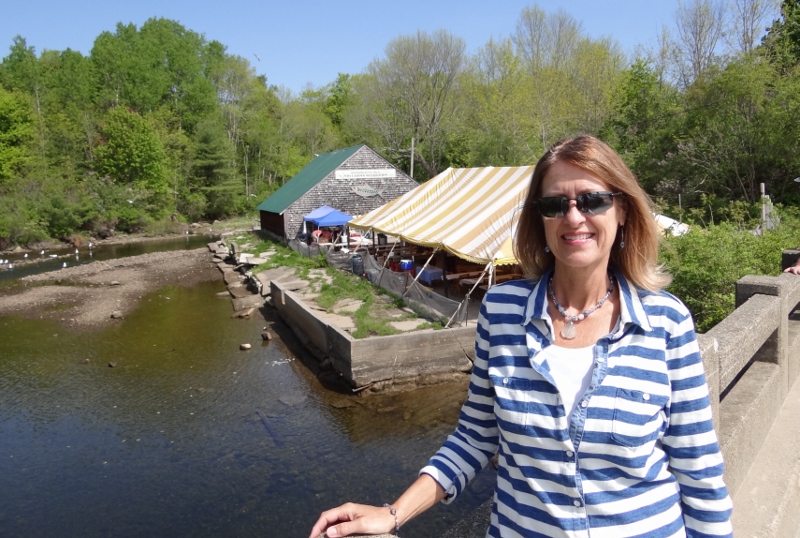
Please don't think I am imitating an alewife!

Please don’t think I am imitating an alewife!

I admit to much-liking the small towns around us; the smaller, older homes, many with plaques proclaiming a pre-1800 date. But when I recall that winter comes in a big way to the northeast, not to mention that the recent epic winter remains a topic of conversation, Maine never makes the list of possible states where we’ll settle down.

Y’all might think the place you live is interesting, maybe even unique, or the birthplace of some well-known person, but I ask you, does your town have an alewife ladder???

Is this thing, 1) a ladder for the tavern-owner’s wife to use to escape drunken brawls; 2) a ladder that leads to the hold in a fisherman’s boat; or 3) a man-made method that allows alewives to migrate to fresh water when a dam blocks their way? Ok that was easy.

But what is an alewife?

They are an anadromous type of herring or shad, which means they live in saltwater but return to fresh water to spawn. They are ten to sixteen inches long; the front of the body is deep and larger than other fish found in the same waters, and its common name is said to come from comparison with a corpulent female tavern keeper. Adult alewives are preferred bait for the spring lobster fishery in Maine, but are typically eaten in smoked form, if at all. Years ago they were salted, packed in barrels and shipped to the West Indies and, more recently they were filleted, pickled and shipped widely as a specialty food. Think I’d pass.

We routinely pick up all the local free newspapers available and for two days over the holiday weekend, the Damariscotta Mills Fish Ladder Restoration Festival would be in full swing. With fresh doughnuts available in the mornings, how could we resist?
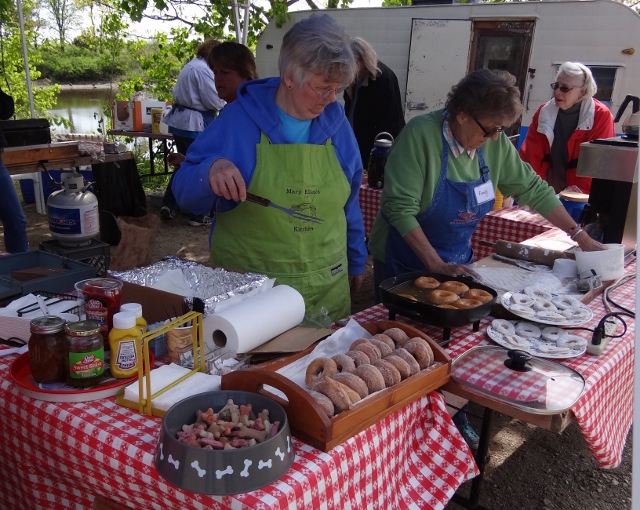
We always seek out yummy doughnuts- have you noticed ?

We always seek out yummy doughnuts- have you noticed ?

Damariscotta Mills, located in the Towns of Nobleboro and Newcastle (north of Rte 1 as opposed to south, where we are), was settled in 1729. A double sawmill was built at the head of the falls between fresh water Damariscotta Lake and the tidal headwaters of the Damariscotta River. Great for the town but lousy for the alewives who couldn’t make their annual migration to fresh water. The legislature said “tut, tut, let those alewives pass” but not until 1807 did the towns construct the ladder and a very basic one at that.

Today’s ladder, which is undergoing an extensive restoration since 2007, rises 42 feet from the bay to the lake. It is composed of 76 resting pools separated by weirs that each rise 8-10 inches. Many have wire covers to keep the seagulls from catching an easy meal. More than one half million will ascend the ladder to spawn.
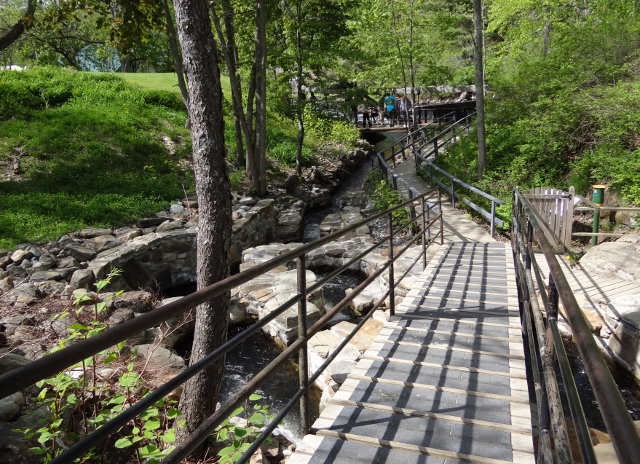
The upper Lower section of ladder
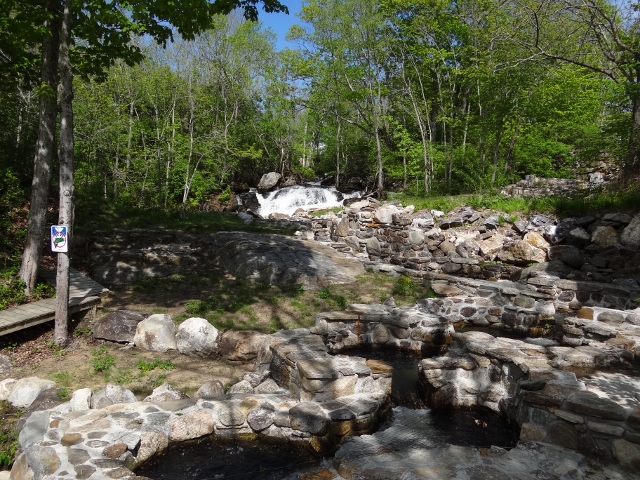
The upper Lower section of ladder

View from group of people in prior photo, looking left up the ladder
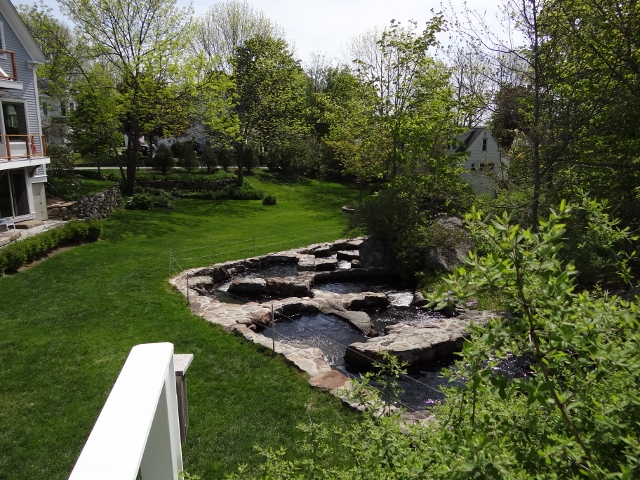
View from group of people in prior photo, looking left up the ladder

The fish ladder touches on private property- good or not?

The fish ladder touches on private property- good or not?

The alewives enter the Damariscotta River in late April and get to the ladder in early May. They wait patiently, coloring the water dark, for their turn to navigate up which, even with the ladder, isn’t easy and only the strongest are successful. Once in the lake each female produces 60,000 – 100,000 eggs which hatch in 3-6 days. Seaward migration occurs between July and November. The juveniles descend the ladder in large schools, typically backing down rather than swimming head first. Now, that I’d like to see.

The fresh water lake at the top

The fresh water lake at the top

The fish are still harvested here, starting the second week of May, and sold as lobster bait which helps the Maine lobster industry in the spring when other fresh bait is scarce.
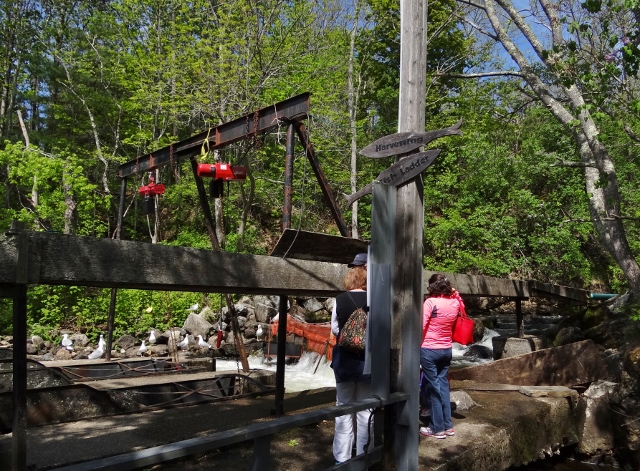
Harvesting begins second week of May- lots of scooping.

Harvesting begins second week of May- lots of scooping.

The festival offered activities and food for all ages, especially the kids. We didn’t hang around long as Port Clyde called out so we missed the poetry reading and music. A woman who lives nearby wrote a bluegrass style song, “Journey to the Lake”; one line goes, “Hungry osprey are waiting to greet them and the eagles’ circling over the bay.” Not only do the fish need strength, they need luck.
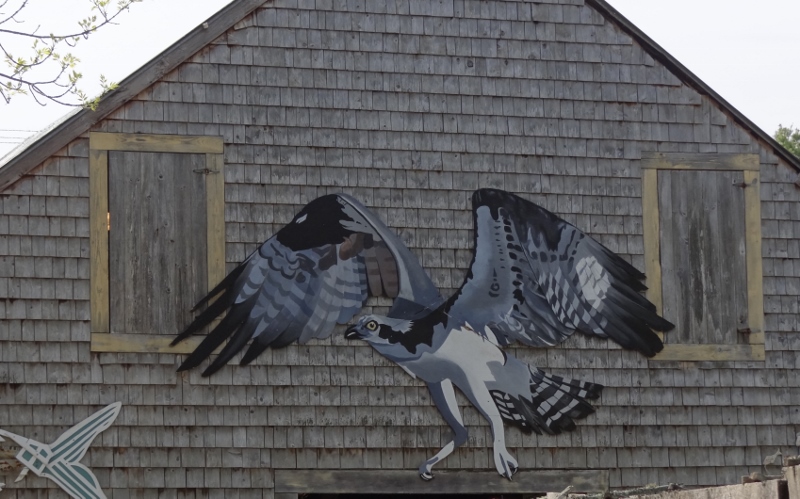
osprey enjoy alewives too

osprey enjoy alewives too

A flock of seagulls hung out (it being low tide when we were there) in the shallows before the ladder area, trying their best to snag a treat.

Gulls try hard to snag a fish
Gulls try hard to snag a fish


Cats and more cats

Fast moving multi-hull

Fast moving multi-hull

Do you find the origin of words fascinating, or least interesting? I do. Find myself delving into word origins more and more; and hey it’s easy these days. How about this word: “catamaran”? The other night Russ and I tossed around some possible countries of origin and you might be doing the same right now …but we didn’t get it right. Try this: India.

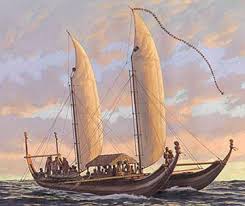
You can check it yourself but here’s the Cliff Notes version: In and around India, vessels which looked to be nothing more than one or two lightweight pieces of wood tied together, were called Kattumarams in the Tamil language. (Tamil is one of 22 languages of India and one of the oldest surviving classical languages in the world). The word meant literally, “tied wood” (from kaṭṭu “to tie” and maram “wood, tree”). When English visitors encountered the swift and stable boats used by the Polynesians two widely spaced canoe-type vessels tied together, the same term was applied and thus today we have catamarans, or “cats” for short.

The same day of the catamaran word history tour, we drove down to lovely Wiscasset then lunched at Mine Oyster in Boothbay Harbor. I walked into only one shop in Boothbay Harbor (yes, I am feeling just fine) where local crafts and other interesting Maine items are sold. One book cover caught my eye; a stunning photo of a Maine Coon cat. Ah yes, the Coon Cat.

Captivating Coon Cat

Captivating Coon Cat

I smiled because if you Google that or do any search for Maine Cat, guess what comes up first? Yep, the Maine Coon Cat, which we never investigated, probably because we were too focused on that Maine Cat catamaran.

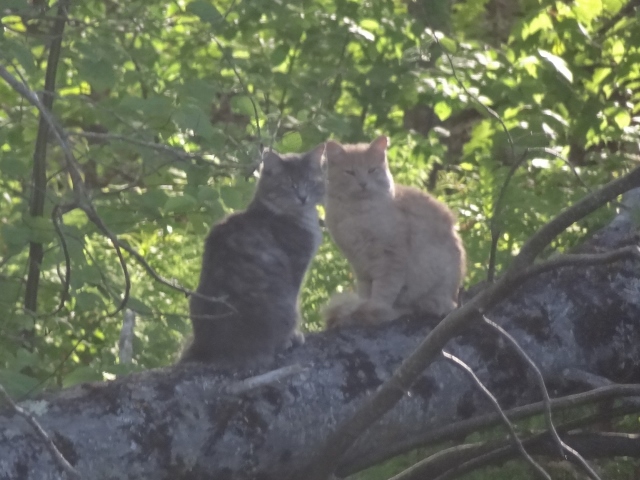
That same evening, there we sat at our tiny dinette table, sipping our Happy Hour libations and minding our own business. We sat inside because thanks to a cold front, the day was chilly, chilly and windy, windy. You get the picture. Our window looks out toward…….. not much, just open space, a barn, a few trees (one fallen) and grassy tent sites beyond. Movement caught my eye and I saw what looked like large, furry cat-like creatures; two of them.

He and she Maine Coon Cats

He and she Maine Coon Cats- taken through window so as not to scare them off

We know next to nothing about cats….. but we do love the ones our family and friends have and share such wonderful photos of!! 🙂 More research was in order and you can just call us your nomadic research assistants for all we routinely Google; most of it we don’t trouble you with!

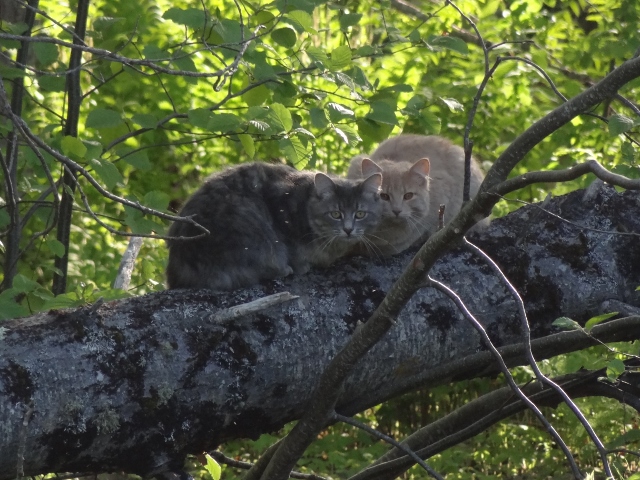
Russ gets their keen attention

Russ gets their keen attention when he steps outside

Maine Coons are quite special; known as “gentle giants”, they are the largest domesticated cat breed in the U.S. and are now one of the most popular cat breeds in the world.  One of the oldest natural breeds in North America, especially native to Maine where they are the official state cat. Can you believe, a Maine Coon cat won the first North American Cat Show in 1895? Intelligent, excellent hunters with long fuzzy/bushy tails and medium to long hair, the one feature that assures you that you are indeed staring at a Coon cat is their slightly tufted ears. Look carefully at their ears in the above photo: see?

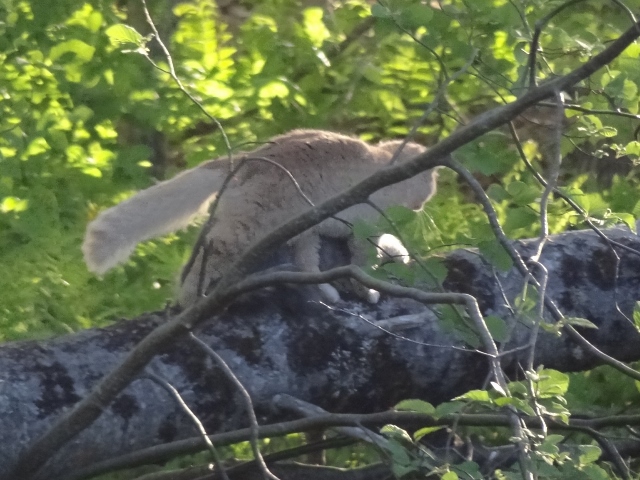
In the photo below you get a good look at the female’s tail. How do I know that she’s the female? At first I just labeled the light-colored one the female, but then …. well Spring IS here and love is in the air. 🙂

Pardon me sir; I take the front seat.

Pardon me sir; I take the front seat.

Now about that name; two folk tales seem to be the most popular, with the more ordinary one (naturally) being the more likely. My favorite goes like this: in 1793 when Marie Antoinette, Queen of France, tried to escape from France (probably to her relatives in Quebec 🙂 ) she brought her beloved Turkish Angora cats with her. She never made it, but her cats – with their nine lives- made it to the Wiscasset shore (weren’t we just there?) where they bred with the local short-haired cats and thus today- oh wait-people who first saw the new version must have seen dark-colored ones and though, “raccoon”. Romantic and all but not very likely.

The generally accepted theory among breeders also involves ships and the sea; perhaps not as boring as I led you believe. A seafaring trading ship Captain, Charles R. Coon often put into port in New England and his brave many-lived long-haired cats traveled with him. In classic literature what happens when a ship stops at a port? The sailors rush to the taverns, eager for brews and wenches. This wild abandon activity would surely include the cats aboard, eager to get away from a ship that offers not one speck of decent kitty litter! When the local population noticed cats similar to the ship’s long-haired cats with a touch of ‘common’, they called these felines “Coon’s Cats”. Take your pick, find another or make up your own story; but if you have a better one, you’d better share.  P.S. I gave Captain Coon the middle initial “R”.